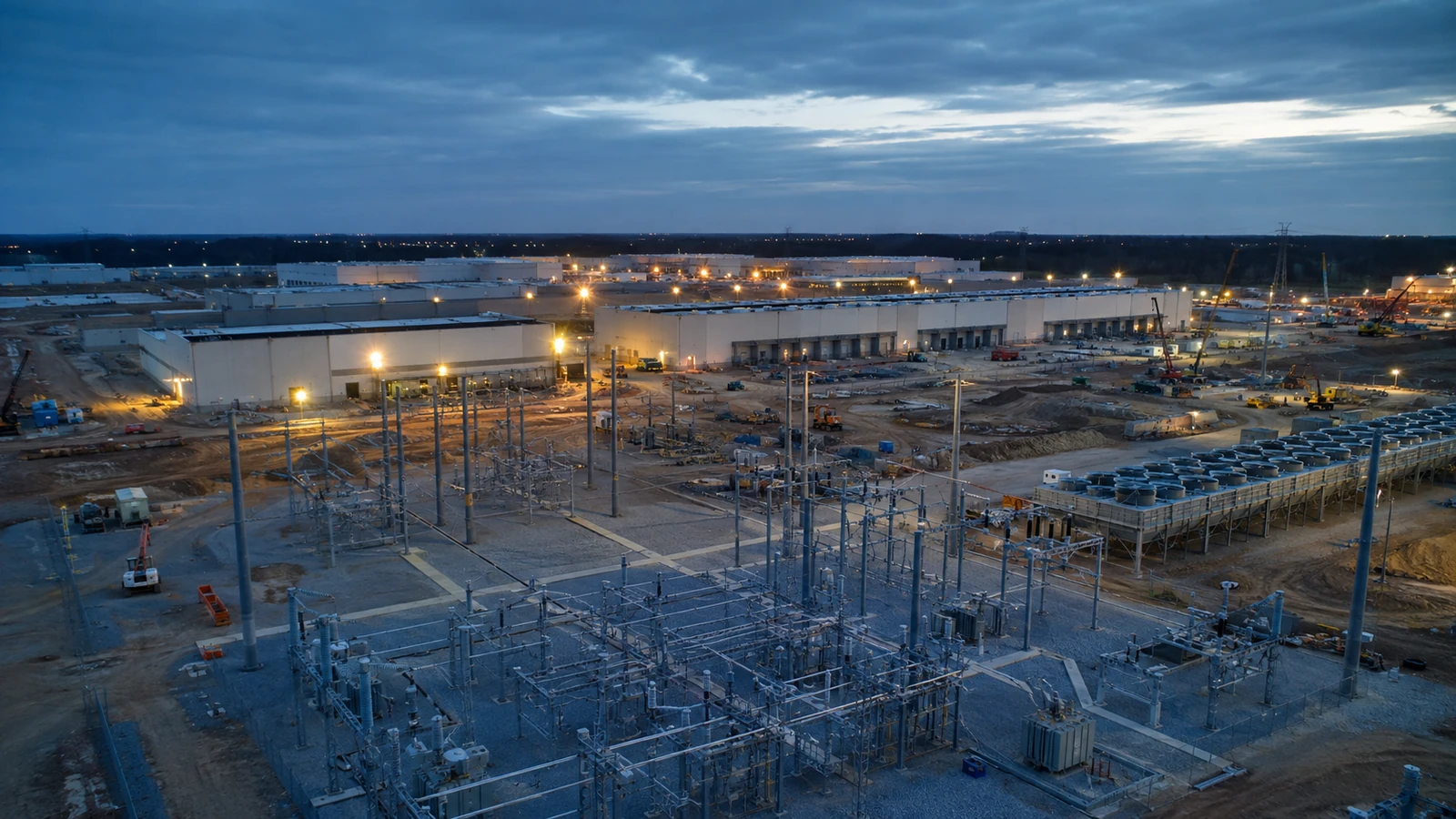
AI investment is no longer one trade. It is a chain of businesses that design chips, manufacture them, connect servers, cool racks, deliver electricity, build data centers and sell compute. Investors looking at AI infrastructure stocks should examine which layer captures revenue, how much capital it consumes and what happens when supply catches demand. A company can sit beside the boom and still miss the economics.
The broad trend is physical. Amazon expects about $200 billion of capital expenditure in 2026. Microsoft now expects roughly $175 billion after changing how some data center leases are classified. Meta guided to $115 billion to $135 billion. These figures cover more than AI, but each company explicitly connects the increase to infrastructure, compute and artificial intelligence.
That is enough steel, silicon and electricity to make a chatbot look almost quaint.
Read the trend as a capital stack
Google Trends shows that people search for Nvidia, Microsoft, Google and AMD far more often than generic phrases such as AI infrastructure or data center investment. Its related suggestions point toward AI hardware, cloud infrastructure, semiconductor trends and data center market growth.
This does not make the branded terms better investments. It shows how public attention is organised. Investors see the finished company name before they see the supply chain underneath it.
The more useful view begins with seven layers.
| Layer | What it supplies | Public company examples | What can break the thesis |
|---|---|---|---|
| Cloud and hyperscale | Compute, storage, models and distribution | Microsoft, Amazon, Alphabet, Meta | Capital intensity rises faster than monetisation |
| Accelerators | GPUs, custom processors and related platforms | Nvidia, AMD | Competition, export controls and rapid product cycles |
| Foundry and equipment | Chip fabrication and production tools | TSMC, ASML, Applied Materials | Capacity cycles, geopolitics and customer concentration |
| Memory and networking | HBM, switches, optical links and data movement | Micron, Broadcom, Arista Networks | Pricing cycles and architecture changes |
| Power and cooling | Electrical distribution, backup power and thermal systems | Eaton, Vertiv, Schneider Electric | Project delays, competition and order normalisation |
| Data center property | Land, powered shells, colocation and interconnection | Equinix, Digital Realty | Financing cost, tenant concentration and stranded capacity |
| Generation and grid | Electricity, transmission and grid equipment | Utilities and energy infrastructure suppliers | Regulation, long lead times and local opposition |
These are examples of where exposure can appear. They are not recommendations. Several companies span multiple layers, and most earn substantial revenue outside AI.
Follow spending before the slogan
The hyperscalers are converting AI demand into construction orders, chip purchases and long-lived assets.
Amazon's 2025 fourth-quarter results put expected 2026 capital expenditure at about $200 billion across the company. Amazon said the increase primarily reflects AI investment. It also reported that Trainium and Graviton had reached a combined annual revenue run rate above $10 billion.
Microsoft's latest fiscal 2026 call said the company added another gigawatt of capacity during the quarter and remained on track to roughly double its overall capacity within two years. Its revised calendar 2026 capital expenditure expectation of about $175 billion reflects a shift from finance leases to operating leases for future data center capacity. The accounting line moved. The appetite for capacity did not disappear.
Meta's full-year 2025 results guided to $115 billion to $135 billion of 2026 capital expenditure, driven by infrastructure for its AI programmes and core business.
Alphabet's 2025 fourth-quarter call said roughly 60% of its 2025 capital investment went to machines, with the remaining 40% going to longer-duration assets including data centers and networking equipment. It expected a similar mix in 2026.
The figures support the infrastructure trend. They do not guarantee attractive returns for every supplier. Spending is revenue to somebody, but the identity of that somebody can change with price, architecture and bargaining power.
Separate demand from investment return
Nvidia offers the clearest example of extraordinary operating demand. Its August 2026 earnings call reported quarterly data center revenue of $89 billion, up 18% sequentially.
That number confirms a large market. It says nothing by itself about the return available to a new shareholder at a particular price.
An investment return depends on at least three separate questions.
- How fast can the business grow revenue and free cash flow?
- How much of that growth is already reflected in the valuation?
- How durable are margins when customers, competitors and technology change?
A wonderful company can be a poor investment when expectations leave no room for ordinary execution. A less glamorous supplier can create better returns if cash flow improves faster than the market expects. The spreadsheet remains annoyingly immune to vibes.
Look beyond GPUs
The first AI infrastructure narrative centred on accelerators. The next phase is constrained by everything required to keep those accelerators useful.
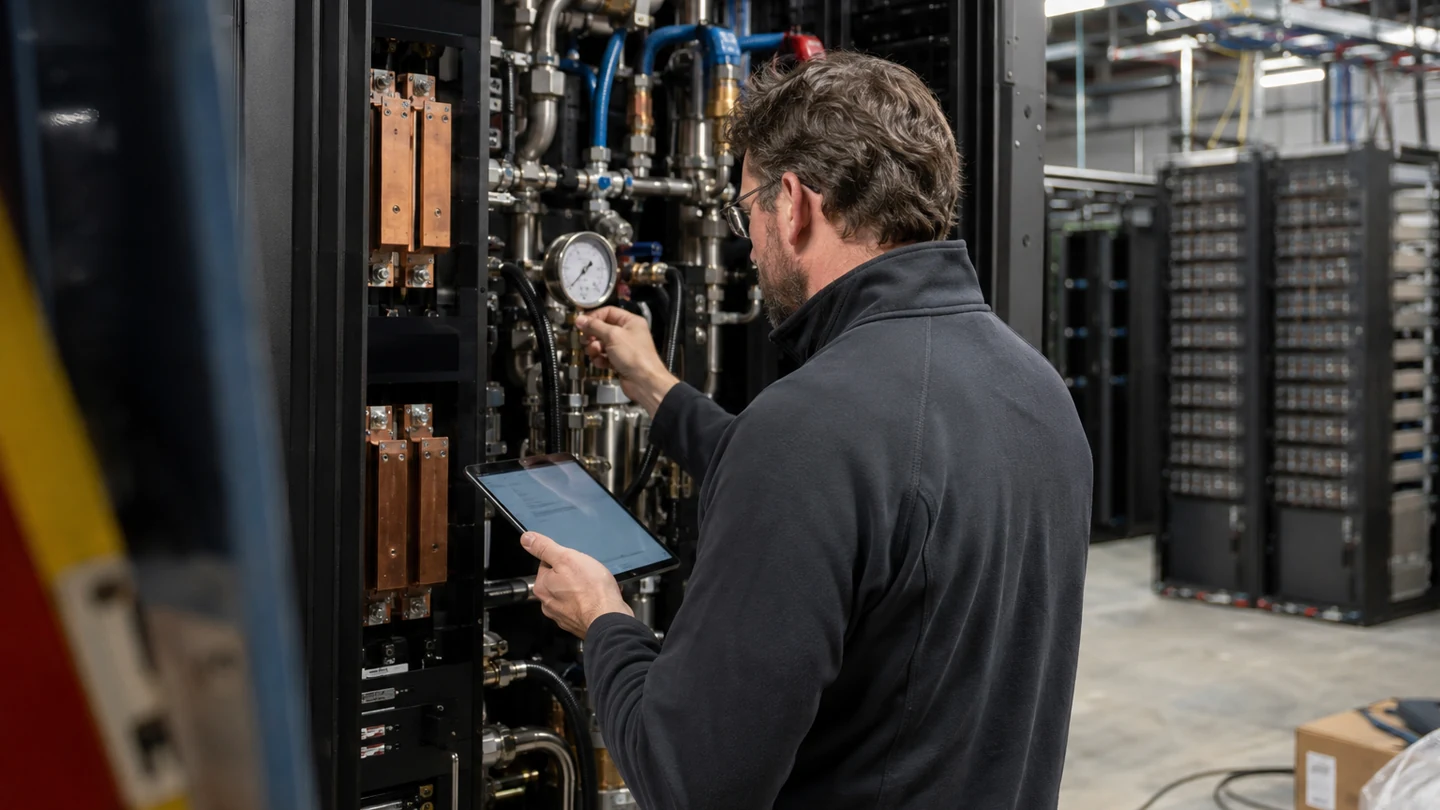
High-bandwidth memory feeds data to processors. Networking moves it between racks and clusters. Optical components carry traffic over distance. Power equipment transforms and distributes electricity. Cooling systems remove heat from racks that are becoming denser. Construction companies turn plans into facilities. Data center operators provide land, power and interconnection.
The bottleneck can move. When accelerators are scarce, chip suppliers hold leverage. When chips arrive before power, energised capacity becomes more valuable. When rack density rises, liquid cooling and electrical design become urgent. When new supply finally opens, utilisation and pricing decide whether the project earns its cost of capital.
This is why a static list of ten AI stocks ages badly. Follow the constraint and the cash flow attached to it.
Treat electricity as part of the product
The International Energy Agency projects global data center electricity consumption to more than double to about 945 TWh by 2030. It expects data centers to account for nearly half of electricity demand growth in the United States through the end of the decade.
This turns AI infrastructure into an energy and permitting story as much as a computing story. A planned data hall without secured power is not capacity. It is expensive architecture waiting for a cable.
Investigate the following before treating power exposure as an easy second-order AI trade.
- Is demand backed by a signed contract or an optimistic pipeline?
- Can generation and transmission reach the site on schedule?
- Who pays for interconnection and grid upgrades?
- Is the project exposed to natural gas, electricity or financing prices?
- Can local planning, water access or community opposition delay operation?
- Does the supplier earn from equipment delivery, recurring service or commodity volume?
Demand can be structurally strong while individual projects remain late, over budget or financially mediocre.
Analyse data center companies like infrastructure
Data center operators and real estate investment trusts can offer direct exposure to powered space and interconnection. Their economics differ from chip companies.
Start with available megawatts, development pipeline, preleasing, utilisation and rent growth. Then inspect debt maturity, interest expense and the capital required to turn land into operating capacity. A large pipeline is valuable only when the company can finance, power, lease and deliver it.
Ask how concentrated the tenant base is. A long contract with a hyperscaler can support financing, but a small number of dominant customers may also negotiate hard. Check whether the company owns facilities, leases them, finances third-party projects or combines all three.
The Meta and BlackRock El Paso venture shows how infrastructure capital is entering the buildout through partnerships rather than ordinary technology-company spending alone. The financing structure matters because risk can migrate without vanishing.
Use metrics that fit each layer
Do not compare every AI company with the same ratio. A chip designer, a utility and a data center landlord have different economic engines.
| Business type | Useful operating signals | Financial signals to watch |
|---|---|---|
| Hyperscaler | AI product usage, cloud backlog, capacity constraints | Capex intensity, cloud margin, free cash flow |
| Chip and networking supplier | Unit demand, product mix, lead time, customer concentration | Gross margin, inventory, research spending, cash conversion |
| Power and cooling supplier | Orders, backlog, book-to-bill, service attachment | Organic growth, margin, working capital, return on invested capital |
| Data center operator | Megawatts delivered, utilisation, preleasing, churn | Development yield, leverage, interest coverage, funds from operations |
| Utility or generator | Load growth, permitted capacity, interconnection queue | Rate base, project cost, debt, regulatory return |
Track changes over several reporting periods. One quarter can be distorted by deliveries, lease accounting or a single project. A trend needs more than one dot, however enthusiastically the investor presentation colours it.
Test the bear case before buying the theme
The strongest argument for AI infrastructure is visible demand backed by enormous budgets. The strongest counterargument is that enormous budgets can create enormous supply.
Build a bear case around five risks.
Supply catches demand
Cloud capacity can move from scarce to abundant. Pricing pressure would travel backward through servers, components and new construction.
Models become more efficient
Lower inference cost can expand demand, but it can also reduce compute required for a fixed task. The net effect depends on whether usage grows faster than efficiency.
Customers design around suppliers
Hyperscalers build custom chips, software and networking to reduce cost and supplier dependence. A dominant vendor can remain important while losing part of the economics.
Power and permitting delay revenue
Equipment can be ordered before a site can be energised. Delays trap capital and postpone cash flow.
Valuation assumes a flawless decade
The US Securities and Exchange Commission's published fund disclosures repeatedly warn that a thematic strategy may identify the wrong beneficiaries or develop differently from the expected theme. That is a dull sentence with excellent survival instincts.
Build exposure without pretending to predict one winner
Investors can approach the theme through individual companies, diversified funds or a broader portfolio that already contains large technology businesses. Each route changes the research burden and concentration risk.
For individual stocks, require a written thesis with the source of AI exposure, the operating metric that should improve and the condition that would prove the thesis wrong. For a thematic fund, inspect holdings, fees, concentration and whether the portfolio actually owns the advertised economic exposure. A fund with AI in its name can still contain a surprising quantity of ordinary software and marketing confidence.
Do not treat this article as personalised advice. Investment suitability depends on objectives, time horizon, tax position, liquidity needs and capacity for loss. Verify current filings and consider regulated professional advice where appropriate.
Connect infrastructure spending to business adoption
The buildout earns its return only if companies purchase and use AI services productively. That link is easy to skip when capital expenditure becomes the headline.
Read how enterprise AI moves from pilot to scale and compare AI agents with fixed automation. These operating decisions determine whether new compute becomes useful revenue or very sophisticated warm air.
For a business buyer, use the AI stack optimiser to compare model fit before committing to one platform. For an investor, watch whether cloud revenue, customer workloads and free cash flow begin to justify the installed capacity.
Keep the thesis measurable
AI infrastructure is a broad, durable capital trend supported by company spending, data center construction and rising electricity demand. It is not a permission slip to buy every company that mentions AI.
Map the value chain. Identify the current bottleneck. Measure revenue quality, capital intensity and valuation. Then write down what would change your mind.
The physical buildout is real. The investment return still has to be earned.
Frequently asked questions
What are AI infrastructure stocks
AI infrastructure stocks are publicly traded companies that supply the computing, networking, memory, power, cooling, property or cloud capacity used to train and run AI systems. Exposure varies widely and may represent only one part of a company's revenue.
Are data center stocks the same as AI stocks
No. Data center companies provide property, powered capacity and interconnection for many digital workloads. AI can increase demand, but returns also depend on financing, occupancy, customer concentration, electricity access and development cost.
How can investors evaluate an AI data center company
Review delivered and planned megawatts, preleasing, utilisation, development yield, leverage, interest coverage and tenant concentration. Confirm that new capacity has credible power, permits, financing and a path to operation.
What is the biggest risk in AI infrastructure investing
The central risk is paying a valuation that assumes demand, pricing and margins remain exceptional while supply, competition and technology evolve. Other material risks include power constraints, project delays, customer concentration, regulation and rapid equipment obsolescence.