A project team reports that AI has removed 30% of the work from a $12 million operation. The finance director asks which costs will leave the budget this year.
That question deserves a separate calculation.
Enterprise AI ROI compares attributable financial benefits with the full cost of delivering them over a stated period. Faster work can create capacity, improve service or support growth. The financial return depends on what the organisation does with that capacity and when the benefit becomes real.
In its 2026 survey of 100 senior technology leaders, Battery Ventures reported that 53% saw clear returns in some areas of AI investment, while only 6% had a consistent organisation-wide measurement framework. Those are self-reported findings from a defined sample, not a success rate for all enterprises. They do show why project-level gains and a defensible enterprise financial account need separate attention. Battery survey context and measurement findings.
Build the case from a budget line
Consider an illustrative shared-services operation with $12 million in annual labour costs. The following numbers are assumptions for a worked example, not Amalgama client results or an industry benchmark.
Suppose 40% of its work is eligible for the proposed AI workflow. Testing indicates a 30% reduction in handling effort within that eligible work. At full adoption, the annual labour-capacity equivalent is:
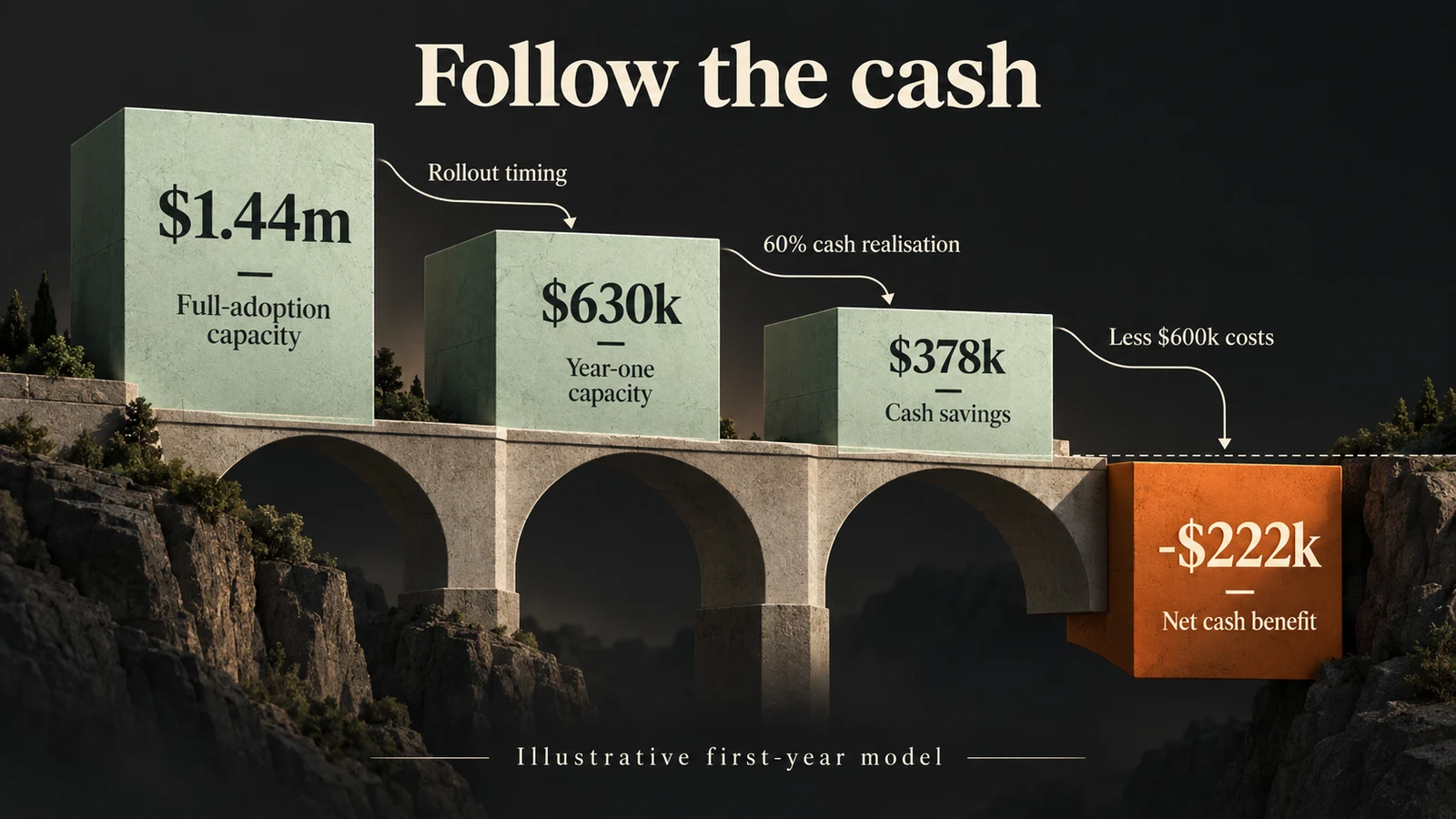
$12,000,000 × 40% × 30% = $1,440,000
The 30% improvement does not apply to the whole operation. It also does not establish a $1.44 million cash saving.
Some capacity may absorb demand growth. Some may remove overtime or external support costs. Some may remain fragmented across roles and shifts, making it difficult to redeploy. Identify the mechanism before assigning a financial benefit.
Put implementation time into the calculation
Assume the first quarter is spent implementing and validating the system. In the remaining quarters, effective adoption reaches 25%, 60% and 90% of eligible work.
Here, effective adoption means the share of eligible work completed through the new process at the tested level of performance. Do not apply the same adoption discount again elsewhere.
| Period | Effective adoption | Labour-capacity equivalent |
|---|---|---|
| Quarter 1 | 0% | $0 |
| Quarter 2 | 25% | $90,000 |
| Quarter 3 | 60% | $216,000 |
| Quarter 4 | 90% | $324,000 |
| First year | Quarterly ramp included | $630,000 |
The first-year figure is $630,000. Putting the full annual $1.44 million into year one would overstate this example's benefit by $810,000 before considering whether any of it becomes cash.
Now suppose finance can substantiate that 60% of the first-year capacity translates into reduced overtime and external service expenditure. Cash savings are $378,000. The remaining $252,000 is a capacity equivalent to track separately.
That 60% is another assumption to validate, not a standard conversion factor.
Include the work required to keep it running
Assume incremental first-year costs of $300,000 for implementation, $120,000 for software and infrastructure, and $180,000 for review, support and change management. The total is $600,000.
For this example, those amounts are first-year cash outlays. The review and support costs are additional to the baseline and have not already been deducted from the handling-time improvement. An actual investment appraisal should also distinguish cash flows, accounting treatment and internal opportunity costs.
First-year cash net benefit is therefore:
$378,000 − $600,000 = −$222,000
Simple first-year cash ROI is:
($378,000 − $600,000) ÷ $600,000 = −37%
There is no first-year payback under these assumptions. The project could still be worth pursuing over a longer horizon. Build the later-period cash flows, including recurring costs and the cost of further rollout, before claiming that it is.
The governance decisions around the workflow belong in this model. Required checks and exception handling are operating costs. Removing them from the spreadsheet does not remove them from production.
Keep benefits from appearing twice
Use a benefit register with an owner, baseline, calculation, evidence and expected recognition date.
For cost savings, identify the expenditure that will fall. For additional revenue, measure incremental contribution after the costs of serving it and account for other changes that could explain the gain. For released capacity, record what work it absorbs.
Risk reduction needs its own treatment. Estimate changes in event probability and loss severity with the relevant risk owner. Show ranges and uncertainty. Do not book the entire value of a transaction as a saving because the system flagged a possible error.
Nor should the same hour appear once as payroll savings and again as capacity for growth. Allocate it to a documented use.
Let the evidence change the decision
Compare matched work with and without the new process where practical. Our guide to moving enterprise AI from pilot to production sets out how to establish the baseline and assign operating responsibility. Watch the case mix, seasonal demand, service quality and rework. If there was no reliable baseline, reconstruct one from available operational records and state its limitations. Missing baseline data makes attribution harder, not automatically impossible.
A finance review should show how the conclusion changes if adoption is slower, review costs rise or eligible volume falls. It should also make stopping possible. A smaller rollout can be the correct decision when a wider one destroys the economics.
The manager responsible for benefits needs authority to change the operating process. A project lead cannot realise savings from a service contract they are unable to amend.
Amalgama's enterprise AI advisory work brings process economics into the implementation decision. Start an AI workflow assessment with the current cost base and the intended benefit. We can examine what would have to change for that benefit to reach the business.