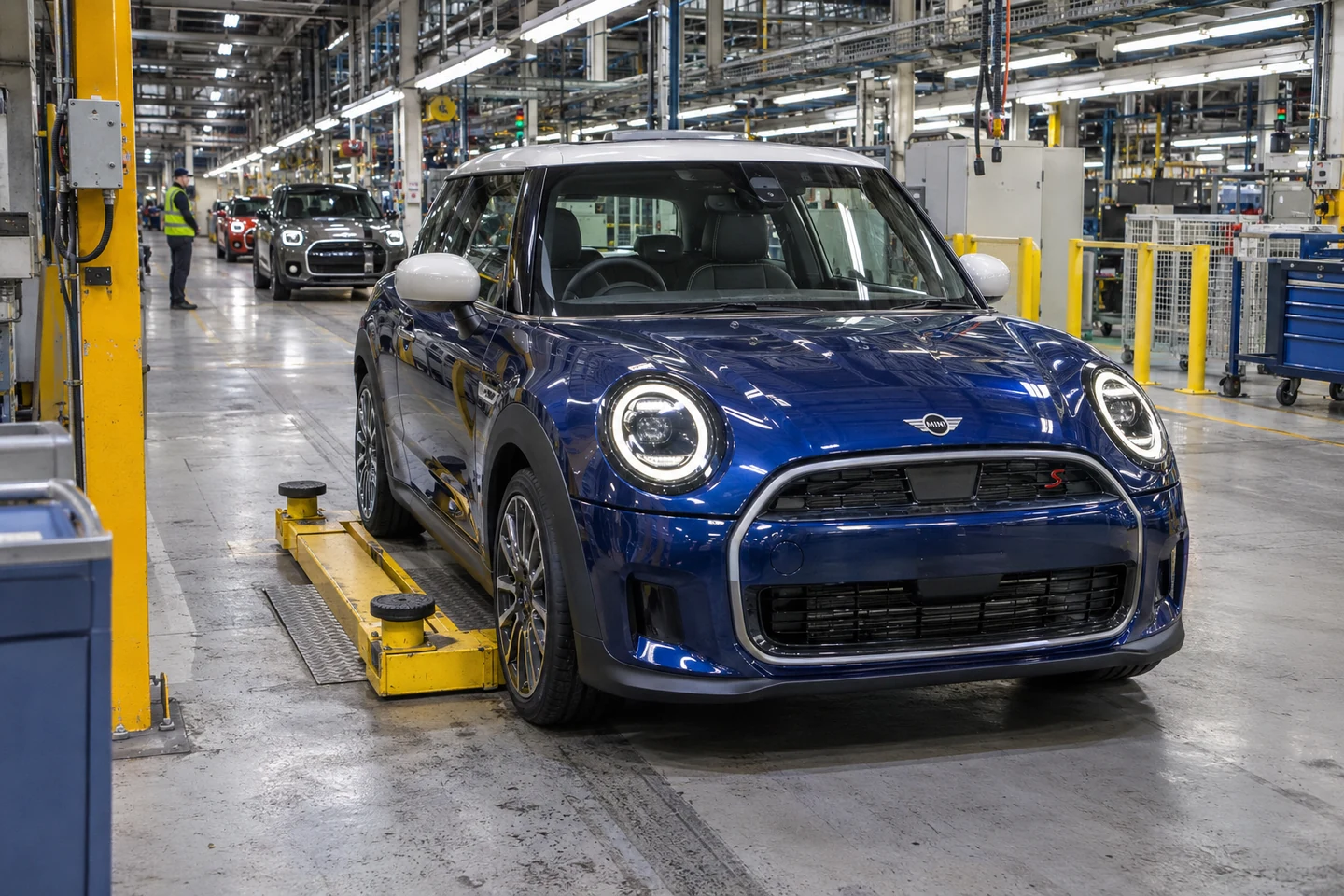
In this reconstruction, the lift is the point where the vehicle hands over to the line. Making that handover work with the existing controls was Oxford’s job.
In Oxford, a MINI has to pull up beside a lifting device close enough for the equipment to take over. The car can make the trip without a driver. Getting the two machines to agree that it has arrived was a job for Oxford. It was the first BMW plant to connect that driving system directly to the controls already running the line. BMW’s account of the Oxford handover
On 30 October 2026 BMW announced a million automated vehicle movements. Oxford was its fourth site, after Dingolfing, Leipzig and Regensburg. Spartanburg in South Carolina was next on the plan for 2027. By the time a fifth plant asks for capital, the board has quite good evidence that a car can make the journey. What it still needs is a price for making the journey work there. BMW’s production rollout
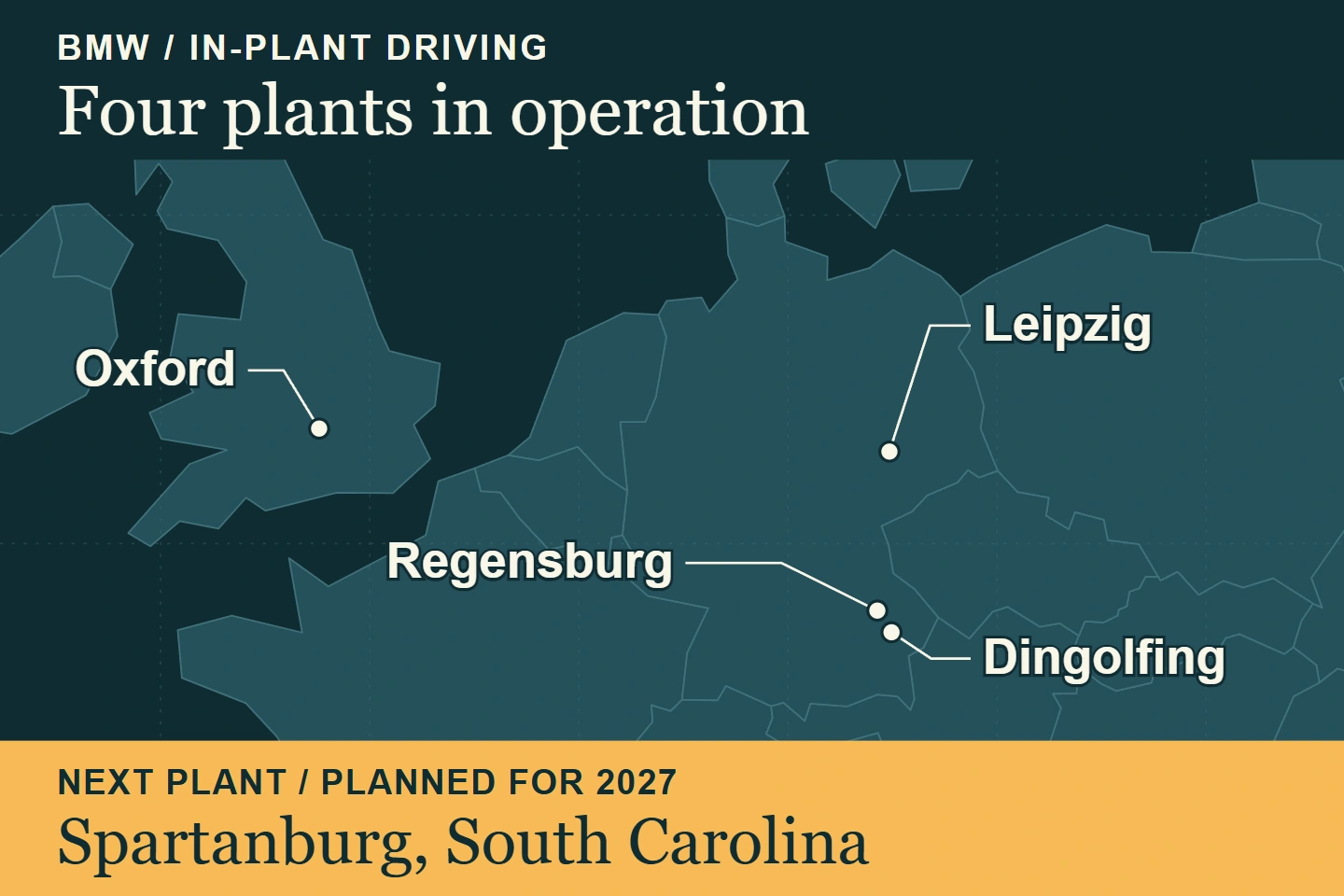
BMW reported four operating sites on 30 October 2026. Spartanburg was the planned fifth site.
What the receiving plant has to price
Since the original 2022 pilot at Dingolfing, BMW had reached roughly 3,500 automated movements a day across the group. Oxford alone recorded more than 53,000 over the preceding year. For a plant director weighing the investment, I’d ask Oxford for two less prominent numbers. How many engineering hours went into the local controls, and how much production time did testing consume? The published totals establish the scale of use. The site estimates belong in the appropriation request. BMW production figures · Oxford integration
That quote needs to cover the route as well as the car. BMW describes sensors along the route, motion-planning software and a cloud connection. The production team at a receiving site knows which aisles it can give up during installation, who is authorised to restart equipment after a stop and when the same lift is needed for other work. A supplier can price the hardware before any of those people have agreed to a shutdown. The cost of that shutdown will still land in somebody’s budget. How BMW’s system works
For a proposed installation, I’d want the plant director to walk the route with the maintenance lead on the shift that will inherit it. Choose one missed handover. Where can the car wait without blocking the next one? Who can release it, and what else does that person have to leave to do so? Time one recovery under agreed test conditions. It gives the investment committee a local cost for an interruption and leaves the shift supervisor with a procedure worth keeping.
A different industrial application shows why fast installation alone makes a poor investment criterion. P&G and Siemens use AI to inspect products on the line. They report commissioning new AI inspection deployments five to ten times faster than traditional vision systems. That matters to the team asking for access to a line. The reported reduction in scrap ranged from 10% to 20% depending on the product. The plant manager needs the number for what comes off that particular line. Siemens and P&G deployment report
What it would cost to be wrong at a small plant
Consider two hypothetical plants competing for the group’s inspection budget. One scraps $4 million of material a year for defects the system could catch. The other scraps $600,000. A 10% reduction in those losses saves $400,000 and $60,000 respectively. Each plant will need another $90,000 a year to run the equipment. The chart shows what remains before either pays for installation.
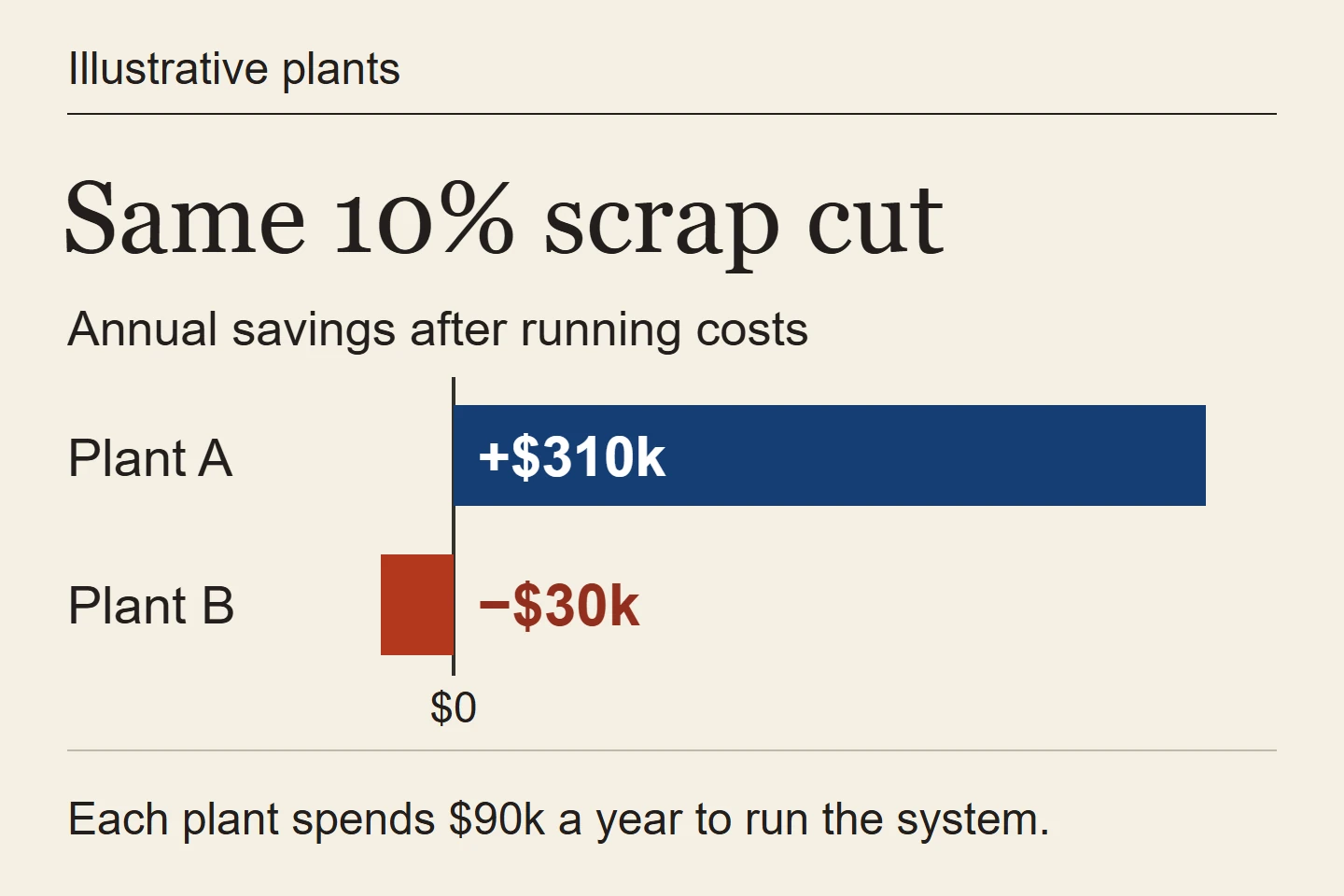
The smaller plant needs a 15% reduction in eligible scrap just to cover running costs. Installation still needs funding.
At the smaller plant, even a 20% reduction would leave just $30,000 a year for installation and any production time lost during the work. Before ordering the equipment, I’d run samples from its highest-volume products and include a changeover. A trial confined to one easy production run could reverse a close investment decision.
The capital quote can change the order again. Suppose installation costs $240,000 per line, payable at the start, and the group requires simple payback within two years. Ignore tax, financing and ramp-up for this screening calculation. Each line has to earn $120,000 a year towards installation after paying its $90,000 running bill. The larger site therefore needs to prevent 5.25% of its eligible scrap. The smaller site needs 35%. Now the plant director knows exactly which number in the trial would justify taking a weekend out of production. Those thresholds belong to this example. Neither company disclosed these installation costs.
There may be another reason to proceed. If a defect could cost the smaller plant a major supply contract, its director should bring the customer’s quality terms and the line’s rejection history. The committee can then judge what it is paying to protect.
A group can have a good reason to back a difficult site first. Suppose three subsidiaries share older line controls. The first plant to develop an interface bears the engineering cost. The other two could use it later. Put that work in the central budget when the other directors commit a test window and an engineer. Without those commitments, the first plant is being asked to finance an option for its neighbours.
Who lends the engineer?
My project experience includes consolidating ERP capabilities from several subsidiaries into one full-service organisation. The issue that translates to industrial AI is who gets the people. A central team may be able to support six plants on paper. The local engineer who knows the legacy controls may also be the only person qualified to return a line to service on the night shift. Somebody has to fund cover while that engineer helps the second site.
For a shared interface, I’d put the reusable engineering in the group budget and leave the shutdown window with the receiving plant. Before releasing that money, ask the second site to name the engineer who will test the interface and reserve an actual production window. Until then, the first plant’s budget should show what its own line can earn on its own.
On the figures above I’d give the larger plant first call on the inspection budget, subject to its installation quote. The smaller plant can come back with results from its own product mix or a customer contract worth protecting. Buying both systems in one procurement round would save a negotiation and commit the group to the weaker investment at the same time. Taking an enterprise AI pilot into production