
If your consulting partner uses AI to complete a piece of work faster, what changes on your invoice?
It is a reasonable question for a client to ask. It also sits close to the investor concern in Bloomberg's September 30 report on Julie Sweet and Accenture's AI pivot. AI creates demand for new consulting work while making some existing delivery tasks cheaper. A firm selling the transition has to manage that transition inside its own business.
My view is that this should change how enterprise clients commission consulting. Ask where productivity gains go, how the supplier proves that quality holds, and which operating costs remain after the project team leaves. Those questions belong in the contract while both sides still have a reason to answer them.
Read the Accenture numbers with their dates attached
This analysis was prepared before Accenture's scheduled October 1 full-year results announcement. The financial figures below refer to its third quarter, not its full-year performance.
Accenture's third-quarter fiscal 2026 results, covering the quarter ended May 31, show revenue of $18.72 billion, up 6% in US dollars and 3% in local currency. New bookings were $19.32 billion, down 2% in dollars and 3% in local currency. The operating margin rose to 17%.
Revenue growth alongside lower new bookings deserves attention. It does not establish that AI has already damaged Accenture's business. Bookings and recognised revenue measure different stages of work, and a quarter cannot isolate technology effects from deal timing or economic conditions.
There is a more useful question for a buyer than trying to settle Accenture's valuation. When a supplier improves its own delivery economics, how much of that improvement reaches the client through a lower cost, shorter delivery time or a better result?
A fixed-price project can reward a consultant for becoming more efficient. A time-based engagement needs a credible explanation of the effort that remains. Both can work. Both can also leave a client paying for activity it no longer needs.
The other consultancies are changing the offer too
BCG's report on its 2025 business, published in April 2026, puts revenue at $14.4 billion. AI and technology services together accounted for more than 40% of revenue, while AI services grew 25% year on year. The scope matters. The 40% figure includes technology work beyond AI.
Capgemini's July 2026 results and upgraded outlook describe another route. The company is combining AI with business operations, including capabilities acquired through WNS. Its first-half growth includes acquisitions, so it would be misleading to read the headline increase as organic demand for AI consulting alone.
IBM provides a particularly relevant example for procurement teams. IBM Consulting Advantage equips its consultants with AI assistants, agents and applications for delivery work. The consultant's own working method is part of the proposition.
These developments give clients specific things to examine. BCG's numbers show the commercial weight of AI and technology work within its business. Capgemini's approach connects AI to the operation of business processes. IBM describes tools intended to change how consulting gets done. None of those statements, by itself, tells a customer what their project will achieve.
For me, the useful competitive question is who can turn these capabilities into a service the client can measure and, eventually, operate with confidence.
Some of the valuable work gets harder
Giving software permission to act introduces decisions about authority and liability. A model connected to a business system inherits the consequences of mistakes in that system. Faster production can also create more material to check, which adds to the evaluation workload unless the review process improves with it.
Accenture's September 18 announcement with Anthropic describes a planned team of embedded evaluators working on model testing, red-teaming and safeguards. Julie Sweet's formulation is useful here:
"Safety requires both deep technical expertise and a clear understanding of how AI is used in the real world."
That is a stated direction for the partnership, rather than evidence of a completed client outcome. It does identify a demanding area of work. Testing whether a model can answer a question is a much smaller assignment than deciding whether it may alter a supplier record, release a payment or make a commitment to a customer.
In an enterprise project, someone has to investigate those permissions, define the exceptions and agree who responds when the system behaves unexpectedly. That person needs access to the people doing the work. Our approach to AI adoption beyond everyday ChatGPT use starts with this operational detail.
I would expect the balance of consulting effort to change. Drafting, research and parts of implementation may become cheaper. Judgement about where to intervene, followed by integration and operational accountability, still needs to earn its fee. A supplier should be able to show that changing balance in its proposal.
Put the customer's economics on the same page
Consider a hypothetical accounts-payable project. A model reads an invoice and proposes the accounting fields. The demonstration takes seconds. The finance team then discovers that someone must resolve missing purchase orders, verify changes to bank details and correct the same supplier's documents every month.
If those activities are outside the scope, the productivity estimate may survive in the presentation while the work returns to the finance team.
For invoice-processing automation, I would ask the supplier to track the whole route from receipt to an accepted accounting entry. Measure review time, corrections and unresolved exceptions alongside the extraction itself. Keep payment authorisation under the controls finance has approved.
The same discipline applies to the commercial terms. An outcome-linked fee sounds attractive until the two sides discover they count the outcome differently. Does a completed case include one that a client employee had to repair? Who pays when incoming documents deteriorate? Can the supplier reject difficult cases and still report a high success rate?
Those definitions determine whether the arrangement rewards useful work.
| Contract decision | What I would ask to see |
|---|---|
| Scope | The full process boundary, including review and exception handling |
| Productivity | Baseline effort and quality measured on a representative workload |
| Acceptance | Tests on cases withheld from development, with agreed failure limits |
| Commercial model | How reduced delivery effort affects fees, scope or delivery time |
| Ongoing operation | Named responsibility for monitoring, updates and failed runs |
| Exit | Usable documentation, agreed access and a tested handover |
There will be projects where uncertainty makes a fixed outcome commitment premature. Commission a bounded diagnostic first. The useful result may be evidence that the proposed automation should be narrowed or stopped. Discovering that before a major rollout is work worth paying for.
Leave the client able to run the work
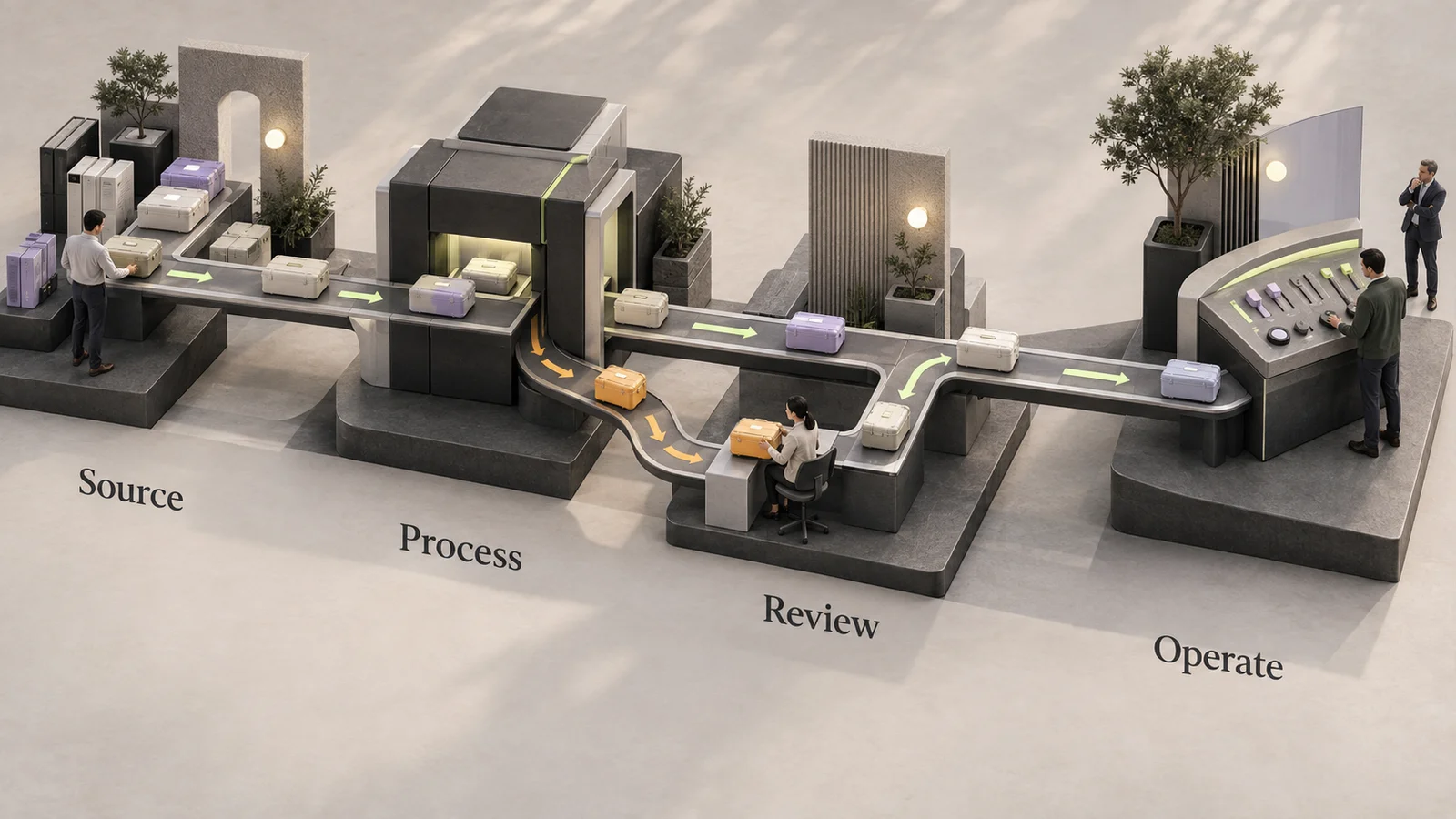
Include exception handling and operating controls in the handover test.
One of the least convincing ways to measure an AI programme is to count how many employees attended training. Attendance is easy to report. It leaves open whether people can recognise an incorrect output, handle an exception or improve the process themselves.
For a client building internal capability, I would include an operational handover test. Ask the client's team to run the workflow, investigate a failed case and make a permitted change using the delivered documentation. Observe where they still depend on the consultant. Then decide which dependencies are acceptable and which need fixing before completion.
This is also how a smaller consultancy can make a credible case alongside large firms. The conversation can focus on a defined process, direct access to senior judgement and evidence from the client's workload. Large programmes may need the geographic coverage and specialist capacity of a global provider. A tightly scoped operational problem may need a much smaller team. The choice of AI consulting company should follow that distinction.
At Amalgama, I bring enterprise technology and operating experience to these decisions. The questions I want answered early concern the work itself. Where does it queue? Who can authorise a change? What does an error cost? Which capability should the client retain? The delivery plan follows from those answers.
Accenture's investors will keep judging its response to AI. Clients have a decision they can make now. At the next renewal, ask the supplier to show how AI has changed the effort required to serve you, and let that evidence shape the next agreement.
If that conversation is overdue, bring Amalgama one workflow and its current constraints. We can help establish what the next consulting engagement should be accountable for.