
Read this imagined job description. Monitor an inbox. Extract details from incoming requests. Update the CRM. Chase missing information. Prepare the weekly report.
Somewhere near the bottom, the successful candidate will probably need to be proactive.
Before recruiting for that combination of duties, I would want someone to explain which parts have been tested for automation. Much of the work follows a recurring digital route. It arrives in a system, requires information from another system and ends with a record or a message. An AI agent may be able to take on enough of that route to change the hiring decision.
Review open operational vacancies for automation potential before approving another recurring salary commitment. A supervised agent may absorb a bounded workload or change the role enough that the job description needs rewriting.
The vacancy is a useful moment to ask. You can redesign the work before a new employee inherits all of its avoidable friction.
Start with the verbs in the job description
The title "operations coordinator" tells you very little about what can be automated. The verbs underneath it are more revealing. Copy, check, retrieve, reconcile, schedule and summarise each suggest a task you can observe and test.
Follow one actual request through the business. Note the information it needs, the decisions involved and where it waits. Ask the people currently covering the vacancy to show the exceptions. The undocumented phone call that resolves a disputed order may matter more than the ten routine steps around it.
AI agents can interpret a request, use connected tools and carry out permitted steps towards an outcome. Their usefulness depends on access to reliable information and on limits around what they may do. A fixed transfer between two systems may only need conventional automation. Our guide to AI agents and business automation explains how to choose between these approaches.
That distinction can save a business from buying an elaborate agent to perform a spreadsheet import.
Look closely at these five kinds of vacancy
The following are starting points for investigation. The proposed automation needs testing against the actual workload, and the retained responsibilities need an owner.
| Vacancy being considered | Work worth testing with an agent or automated workflow | Responsibility to retain with people |
|---|---|---|
| Sales operations coordinator | Extract inbound enquiry details, prepare CRM updates, flag missing information and draft follow-ups | Qualify ambiguous opportunities, negotiate terms and approve commercial commitments |
| Accounts-payable assistant | Extract invoice fields, retrieve purchase orders, run matching checks and route discrepancies | Resolve disputes, approve supplier bank changes and authorise payments |
| Customer support coordinator | Classify requests, retrieve approved guidance, draft replies and handle narrowly defined status enquiries | Investigate sensitive complaints, approve exceptions and manage customer relationships |
| Project administrator | Extract proposed actions from meetings, prepare status updates and flag missing owners or dates | Confirm commitments, negotiate priorities and resolve dependencies |
| Reporting analyst focused on routine packs | Gather approved data, run reconciliations and draft commentary linked to source figures | Define metrics, investigate unexplained changes and advise management |
Each row can lead to a different staffing decision. A sales team may still need another commercial person after administrative work is reduced. A finance team may find that its shortage is concentrated in handling disputes. Hiring someone primarily to copy invoice fields would leave that shortage unresolved.
Two workflows are particularly easy to examine with concrete examples. Take a batch of invoices through extraction and accounting review, or follow a meeting through to confirmed actions with owners. You can see where interpretation helps and where somebody still has to decide.
The evidence supports a closer look at the work
The ILO and NASK's 2025 occupational exposure study estimated that 25% of global employment was in occupations potentially exposed to generative AI, with clerical work the most exposed. The authors expected changes within jobs to be more common than complete automation. Their estimate measures exposure, not a count of positions businesses can already remove.
There is also evidence from actual operations. In Generative AI at Work, published in The Quarterly Journal of Economics in 2025, Erik Brynjolfsson, Danielle Li and Lindsey Raymond studied 5,172 customer-support agents. AI assistance increased issues resolved per hour by 15% on average. Benefits varied by worker, with larger gains among less experienced staff. People remained responsible for the conversations.
The study measured assistance to employees at one company, not autonomous agents filling vacancies. It gives a manager a reason to test whether the existing team can handle more demand, but it cannot establish whether a particular hire is unnecessary.
The task-level approach also appears in Anthropic's September 2026 economic scenarios. The model treats jobs as bundles of tasks that AI may assist, automate or leave unchanged, while creating other tasks. Those are scenarios about possible futures. Your recruitment decision needs evidence from the work you have today.
Calculate whether AI changes the hiring decision
Suppose, for illustration, a team needs 120 hours of staff time each week to handle its current work. Its available capacity for that work is 100 hours, after other commitments and planned cover. The 20-hour shortfall is the reason for requesting a hire.
Observation identifies 60 hours of repetitive digital tasks. A trial removes 75% of the staff time within that portion, saving 45 hours. Checking outputs, dealing with exceptions and maintaining the workflow then adds 10 hours of work elsewhere in the team.
| Illustrative weekly workload | Staff hours |
|---|---|
| Original workload | 120 |
| Work removed by automation | -45 |
| New review and maintenance effort | +10 |
| Remaining workload | 85 |
| Net capacity released | 35 |
| Existing team capacity for this work | 100 |
| Capacity left after the trial | 15 |
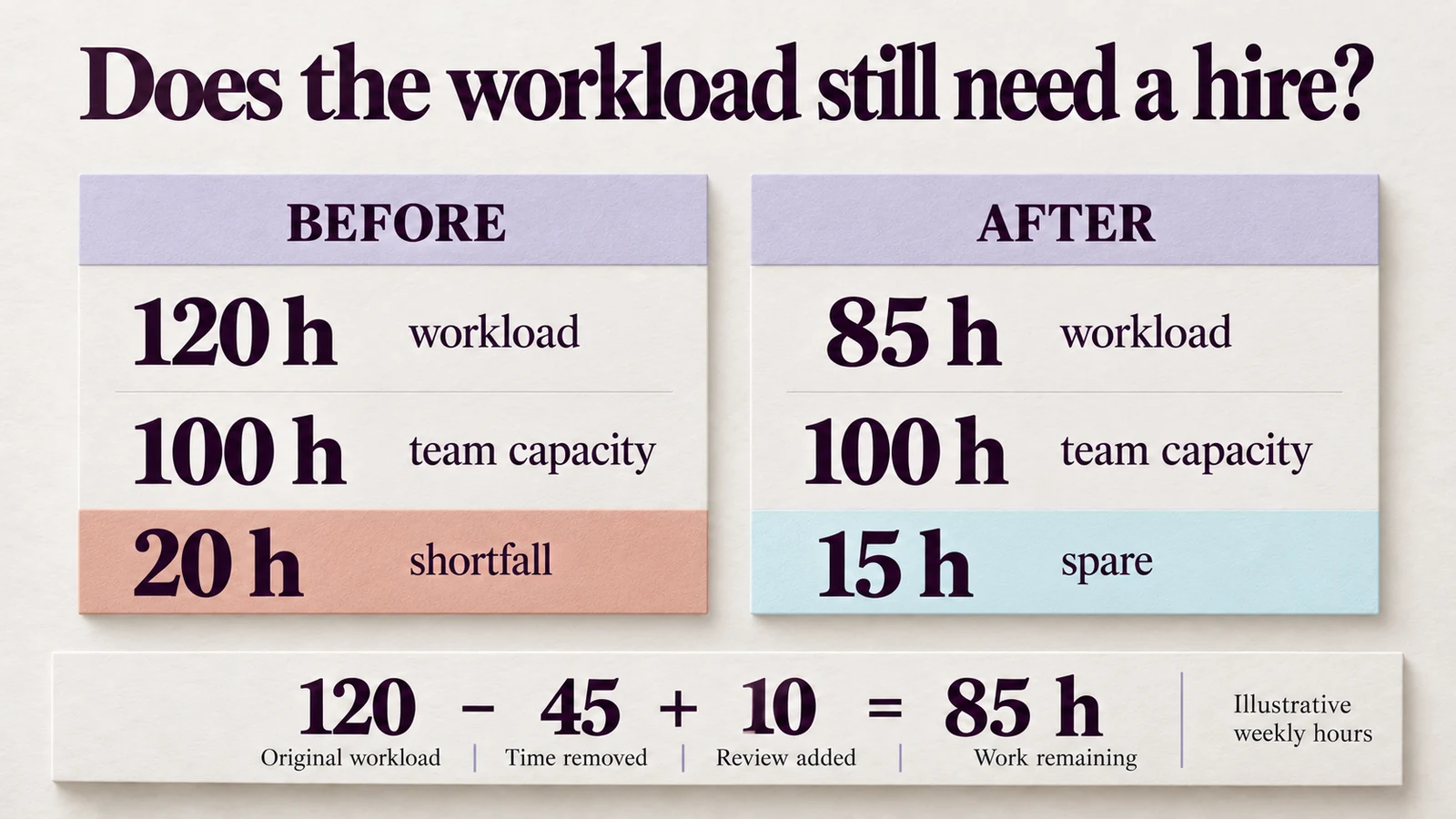
Illustrative weekly hours. The 85-hour workload includes 10 hours of new review and maintenance.
In this example, automation closes the 20-hour shortfall and leaves 15 hours of capacity. Deferring the hire becomes a reasonable option if the existing team has the skills and availability to do the remaining work. Hours saved across different locations or shifts may not combine into one available person. If the work arrives at the same time each morning, average weekly capacity can conceal a daily queue.
Check the remaining 85 hours against the team's actual available capacity, required skills and peak demand. Include absence cover. A recruitment decision based on everybody being present every day is already in trouble before the AI is switched on.
Finance should compare both options over the same period, such as the next 12 months. Set the avoidable salary, employer costs and recruitment fees against implementation, software, model usage, support and internal review time. Include setup costs in the first year. Value review time even when it belongs to an employee already on the payroll. Their other work still exists. Released hours only become a cash saving when a cost is actually avoided.
The result may justify deferring a hire, narrowing the role or recruiting someone with different strengths. It may also confirm that the original vacancy is needed.
Give the agent a supervised trial
Start with historical or otherwise approved cases. Let the system propose an action while the existing process remains responsible for the live work. Include incomplete records, conflicting instructions and requests outside the proposed permissions.
For the imagined inbox role, an adequate trial should answer a few specific questions.
- Does the system attach each request to the correct customer and record?
- Can a reviewer trace the proposed answer to current source information?
- Does it recognise when information or authority is missing?
- What happens when a connected service fails or the same request arrives twice?
- How much staff time remains after review, corrections and escalations?
Agree acceptable error levels with the process owner before examining results. Apply stricter controls to actions with larger consequences. A draft internal update and a change to bank details should not share the same approval policy.
Move to a limited live trial only after those checks pass. Keep a manual route available and make the service owner responsible for monitoring it. Run long enough to include the workload variation that matters, such as a reporting cycle or a busy period. A quiet afternoon is weak evidence for a staffing decision.
If the agent saves time only because a senior employee repairs its work off the books, record those hours and revise the design. Otherwise, the vacancy has simply moved into somebody else's calendar.
Rewrite the human role around what remains
I have led workforce optimisation across large organisations. The durable benefit comes from changing how the operation functions and checking that it continues to perform. Open vacancies offer a particularly useful opportunity because the business can reconsider the work before adding a position.
Include the current team in that review. They know which apparently simple requests turn into difficult cases. They also deserve a clear account of what management is testing and how the result could affect workloads and roles.
Train the people who will review outputs and handle exceptions using cases from the trial. Our approach to systematic AI adoption combines that preparation with process observation, so the revised role includes the work automation leaves behind.
Some vacancies should continue without waiting for an automation experiment. A business may urgently need qualified judgement, physical work, relationship ownership or service coverage. Delaying that hire can cost more than any plausible saving. The review should have a deadline and a business owner, so it produces a decision instead of becoming a reason to leave an overstretched team short of help.
Bring the job description to the next AI discussion
At Amalgama, we can help assess an open vacancy against the process behind it, define a bounded automation trial and work out what the human role should contain afterwards.
Bring us a job description and a representative sample of the work, with confidential material removed or shared through an agreed secure route. The useful output is a staffing decision supported by evidence, including a clear recommendation to hire when the workload requires it.